You can invest in a camera with top-tier resolution, impressive low-light performance and smart analytics, but still end up with footage that doesn’t serve your needs. When that happens, the camera itself usually isn’t to blame it’s almost always the lens.
Take a common scenario: a security team needs to identify anyone coming through a warehouse gate 20 meters away. The installed camera captures a beautiful wide view of the whole loading yard, but the people at the gate are just tiny dots in the frame. Even with high pixel count, there’s simply not enough detail where it actually counts.
Or flip the problem around. A camera might give you a crystal clear close up of the front entrance, but miss the surrounding area you wanted to keep an eye on. In both cases, the cameras are functioning perfectly. The issue is that their field of view just isn’t right for the job.
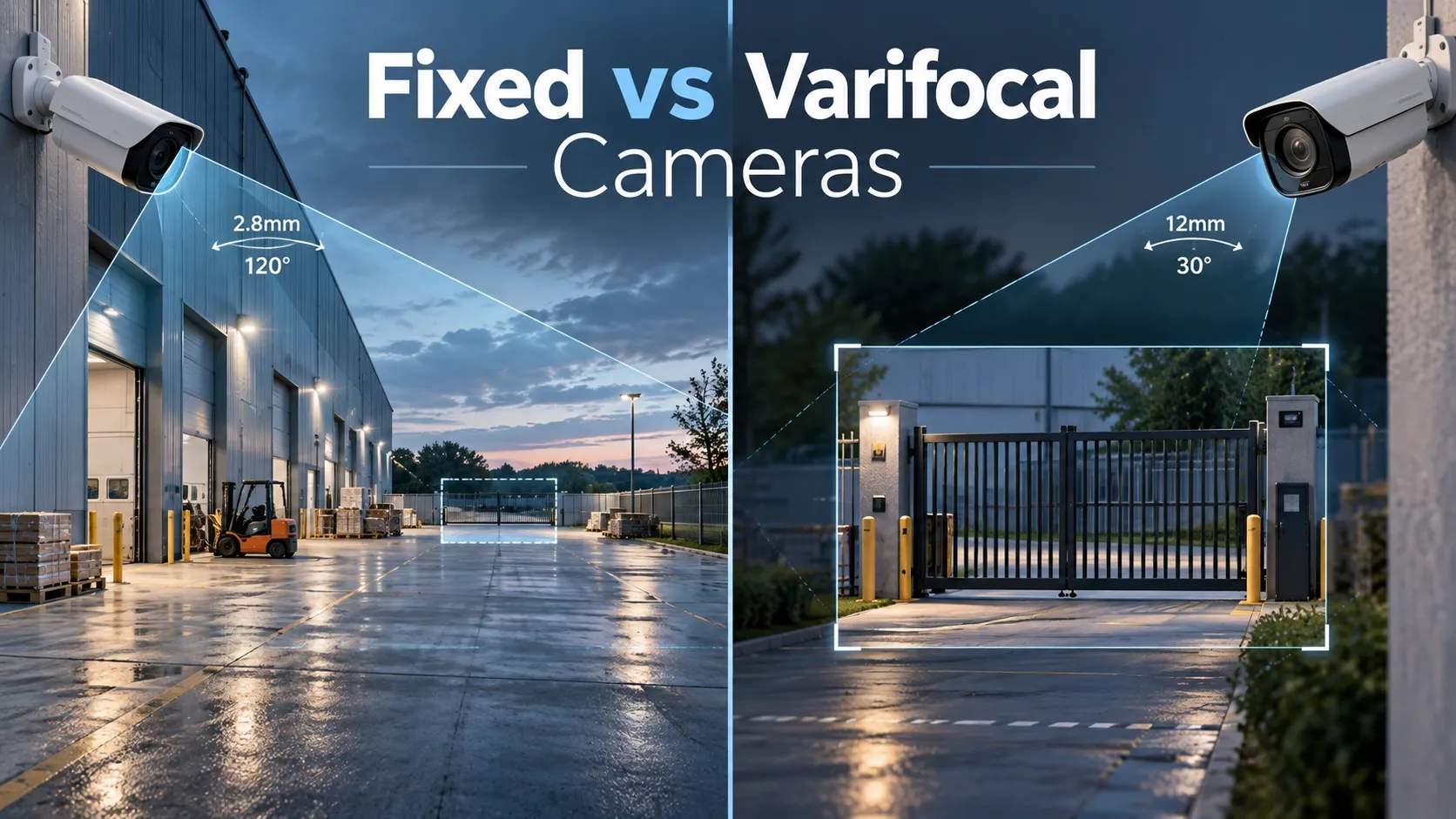
Comparing Fixed vs Varifocal Cameras should happen up front, long before anyone mounts a camera to the wall. A fixed lens gives you one set view. A varifocal lens lets you adjust the focal length on-site to zoom in or zoom out as needed. Neither type is inherently superior. The right choice comes down to what you’re trying to see, how far away your subject is, how much flexibility the site demands, and whether you’ll need to make remote adjustments down the road.
Fixed and Varifocal Lenses Explained
When comparing Fixed vs Varifocal Cameras, start with the simplest distinction: a fixed lens camera has a single, permanent field of view because its focal length never changes. For instance, if it comes with a 2.8 mm lens, that’s what you’re working with. While an installer can tilt or swivel the camera itself, the optical perspective provided by the lens and sensor combo stays strictly the same.
That straightforward setup actually brings a lot to the table. Because they’re so uncomplicated, fixed-lens models are a breeze to specify whenever you have a predictable layout. They’re great for spots like small offices, hallways, storage rooms or entryways where you already know the exact angle you need to cover.
Take the current Tiandy 8MP fixed-lens turret camera, for example, it sports a 2.8 mm fixed lens that delivers a wide horizontal view of around 104.9 degrees. On the other hand, the Tiandy 5MP fixed bullet camera uses a 4 mm lens for a tighter 80-degree horizontal perspective. These options clearly demonstrate how changing focal length alters your shot, even within the fixed-lens family from Tiandy.
A varifocal lens, by contrast, works across a focal-length range.
A 2.7 — 13.5 mm lens for example, can be dialed out wide to sweep a large area or zoomed in close to hone in on a specific distant spot. This core concept is broken down in Axis guidance on surveillance lenses: your field of view depends on both focal length and sensor size, with longer focal lengths giving you a tighter, more focused picture.
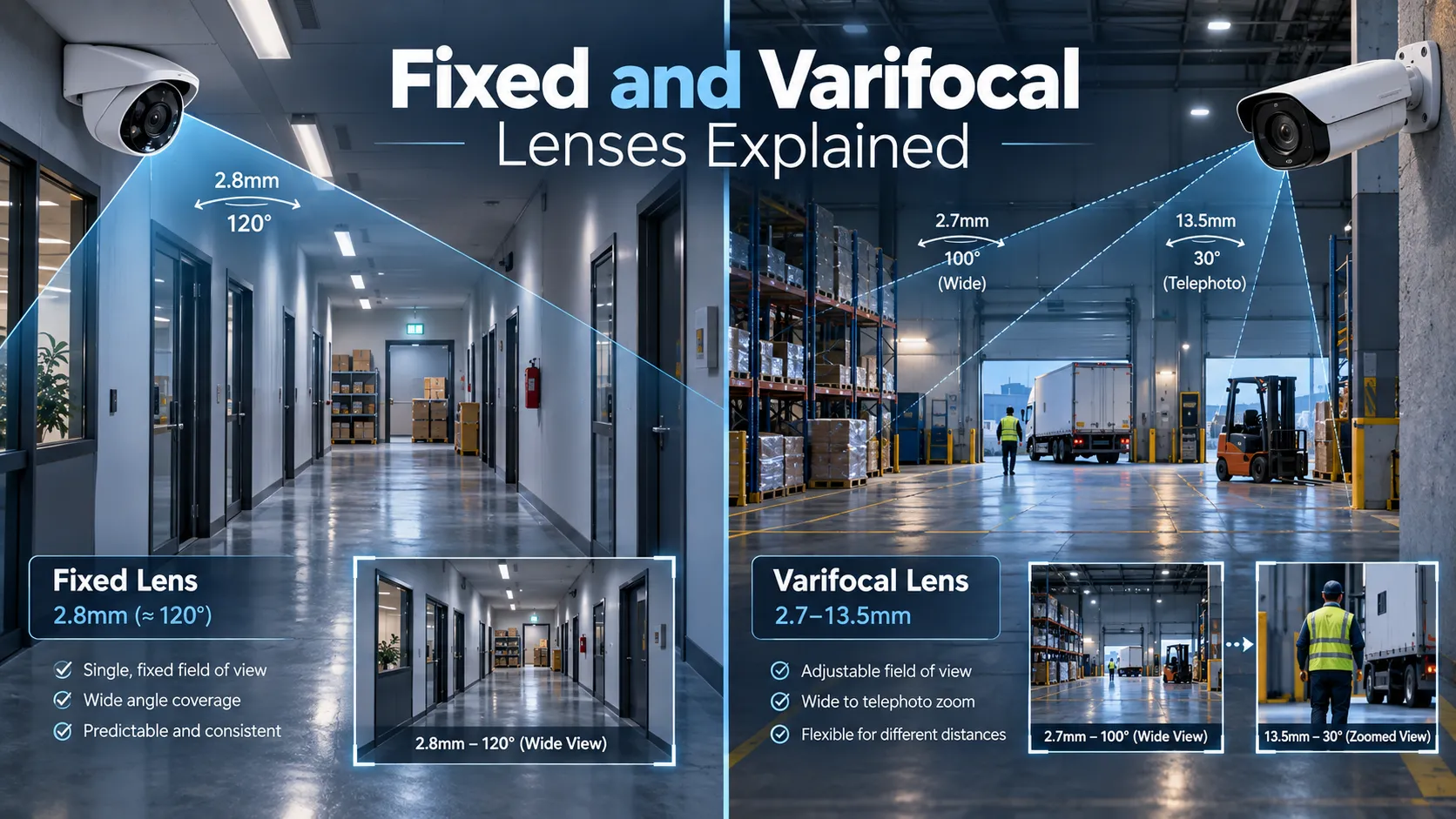
You can see this flexibility in action with the 8MP motorized bullet camera specification from Tiandy. Its 2.7–13.5 mm lens shifts seamlessly from a broad 108.7-degree horizontal view at its widest down to a focused 31.5 degrees at full telephoto. In short, a single camera can be configured for two completely different coverage scenarios without ever swapping hardware.
Focal Length, Sensor Size and Field of View
When we talk about focal length, we measure it in millimeters things like 2.8 mm, 4 mm, 8 mm or 12 mm.
As a quick rule of thumb:
- A shorter focal length gives you a wider view.
- A longer focal length narrows the view, bringing distant objects closer and into clearer focus.
That said, focal length is only part of the story in the Fixed vs Varifocal Cameras comparison.
Sensor size plays a huge role in what you actually see, too. Two cameras with the exact same lens can show completely different views if their sensors aren’t the same size. This is why simply asking an installer for a “4 mm camera” usually isn’t enough: the sensor dimensions and lens need to be considered together to determine the actual field of view.
Instead, try framing your requirement like this:
“We need to cover this specific width from where the camera is mounted, while keeping enough clear detail on subjects at this distance.”
From there, you can choose the right combination of camera, sensor and lens together.
This becomes particularly important in large GCC commercial and industrial sites, where one project may contain narrow corridors, reception areas, warehouse aisles, perimeter fences and large loading yards. Using one lens choice everywhere is convenient for procurement but rarely produces the best surveillance result.
Coverage vs Detail at the Target
When picking a camera lens, this is really the core decision you have to make.
A wide lens gives you a bigger picture, but anything or anyone in the shot will look smaller and have fewer pixels. On the other side, a narrow lens covers less ground, but it gives you much sharper detail on specific targets. That trade-off is at the heart of Fixed vs Varifocal Cameras.
Say you’re monitoring a warehouse gate about 30 meters away. With a varifocal lens set wide, your security team gets a full view of the gate, road and fence, which is great for general monitoring. Zoom all the way in, and while you lose the surrounding view, any person or vehicle at the gate fills the frame with clear detail.
Tiandy shows this difference clearly with their DORI ratings. For example, their 2MP 2.8–12 mm motorized camera can identify a person up to 3.8 meters away on its wide setting, but zooms in to reach about 16.5 meters at telephoto.The lesson is important: resolution alone does not determine useful identification distance.
An 8MP camera set too wide can actually give you less usable detail at a distant gate than a lower-resolution camera paired with the right lens. When planning your setup, start by defining what you actually need to achieve.
Ask yourself if you need to:
- spot whether someone is there?
- see what they are doing?
- recognize someone you already know?
- identify a stranger with complete certainty?
Each goal demands a completely different level of image detail.
Manual vs Motorized Adjustment
Another practical factor in Fixed vs Varifocal Cameras is how easily the lens can be adjusted after installation. Keep in mind that not all varifocal cameras work the same way when it comes to adjustments. If you’re using a manual varifocal lens, the installer has to physically tweak the focal length and set the focus right at the camera itself. Once it’s all dialed in during setup, it stays fixed right there until someone physically goes back up to change it.
For a straightforward, stable setup, that works just fine.
On the other hand, a motorized varifocal camera lets you adjust the focal length electronically. Depending on the system, an installer can fine-tune the field of view right from the software interface, no need to climb a ladder or crack open the camera housing. That’s a huge plus for cameras mounted high up on warehouse ceilings, outer walls, poles, or other hard-to-reach spots.
You can see this convenience in action with modern Tiandy motorized models. For example, its 5MP motorized IR bullet camera features a 2.7–13.5 mm motorized lens, sweeping seamlessly from a broad 98.3-degree horizontal view down to a focused 32.2 degrees.
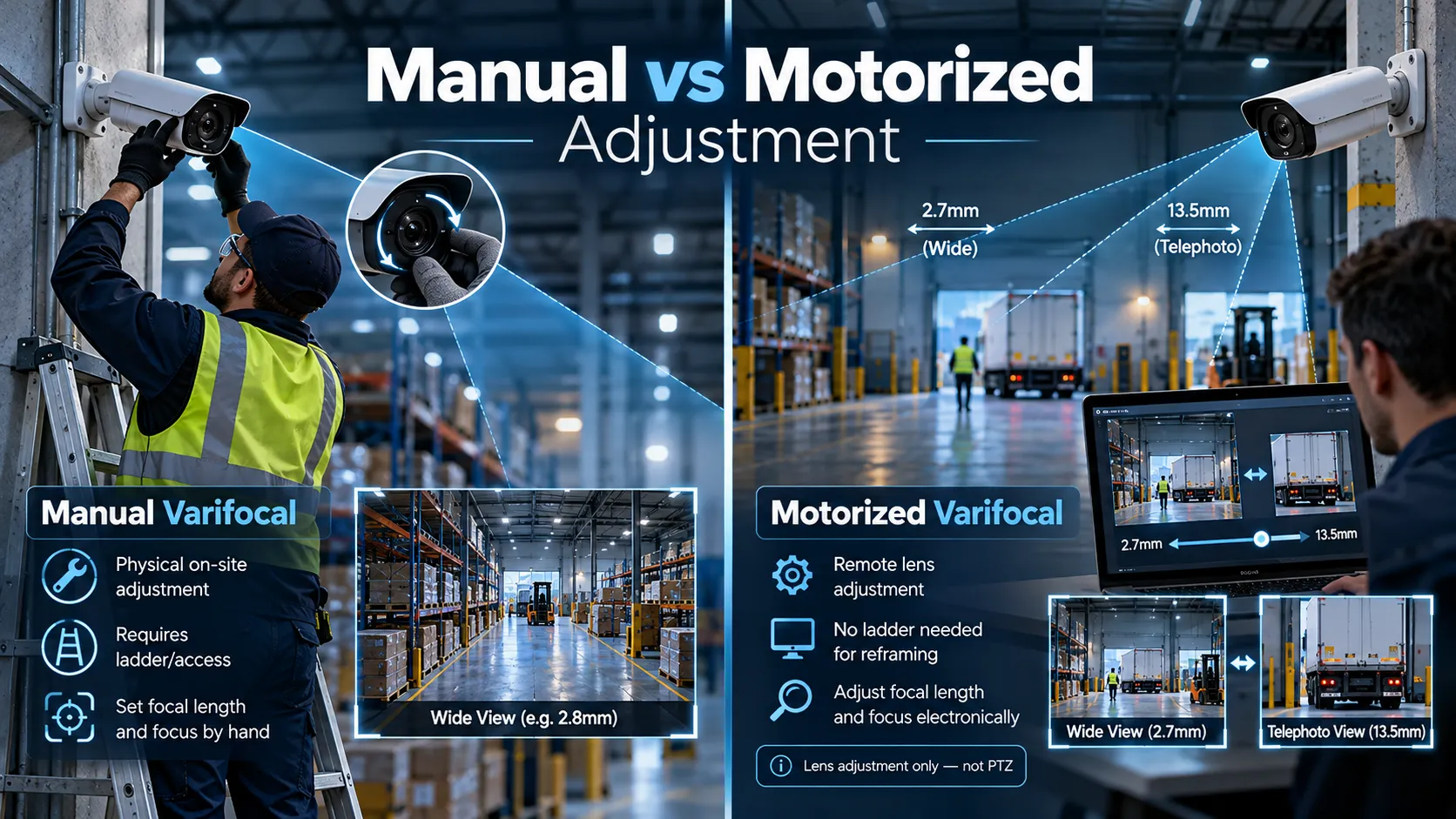
Motorized adjustment also helps during commissioning because the exact framing can be refined after the camera is mounted and real conditions are visible. The camera should not, however, be confused with a PTZ simply because its focal length is motorized. Motorized varifocal adjustment changes the optical framing; it does not necessarily mean the camera can continuously pan, tilt and zoom around the environment.
Match the Lens to the Location
The best lens is the one that matches the actual surveillance task. Comparing Fixed vs Varifocal Cameras only makes sense in the context of the location being monitored. There’s no magical, one-size-fits-all CCTV focal length out there.
Corridors and Entrances
The Fixed vs Varifocal Cameras decision looks different in a narrow hallway than at a busy entrance. Hallways and corridors usually call for focused coverage along a fairly tight straight line. If you go too wide, you end up recording mostly blank walls, floor and ceiling while shrinking anyone down the hall into an unidentifiable blur.
A narrower field of view focuses every available pixel directly on the pathway where people walk.
Entrances are different.If the camera is mounted close to the door and needs to capture everybody passing through it, a wider fixed lens may make sense. A 2.8 mm camera can provide broad coverage without requiring much commissioning. But if the entrance is viewed from farther away, a varifocal camera can be tuned so the doorway fills more of the frame.
For identification, the image of the person matters more than showing every square metre around them.
Loading Bays and Open Areas
In loading bays, Fixed vs Varifocal Cameras often comes down to whether you need broad situational awareness or precise detail at a distance. Open spaces are where varifocal lenses really shine. A busy loading bay often includes truck lanes, bay doors, walkways and outer fences all spread out across different distances.
A wide-angle fixed camera keeps an eye on overall activity, but it might miss crisp details on the far side of the yard. With a motorized varifocal lens, installers can fine tune the view right on site, trading unnecessary width for much sharper target detail.
The same holds true for perimeter security and logistics hubs.
D3’s AEROSKOP surveillance offering focuses on large-scale environments like warehouses, loading docks, industrial plants and perimeters places where camera setups must adapt to complex layouts rather than relying on standard templates.
Tiandy’s motorized cameras offer another great practical solution. For instance, an 8MP 2.7–13.5 mm motorized dome can adjust its horizontal angle anywhere from 106.7 down to 31.5 degrees, giving installers plenty of room to frame open operational spaces perfectly after mounting.
Why Digital Zoom Is Different
The Fixed vs Varifocal Cameras comparison is about optical framing, not about relying on digital zoom later. It is easy to mix up digital zoom with optical adjustments, but they are totally different beasts. Optical lens adjustments actually change how light hits the sensor, focusing all of the camera’s available pixels onto a smaller, specific section of the scene.
Digital zoom begins with an image that has already been captured and enlarges part of it.
That distinction makes a world of difference in practice. Think about it this way: if a person only takes up 150 pixels in a wide shot, zooming in digitally won’t magically reveal finer details like facial features. The software can blow up the pixels, but it can’t invent details that were never recorded in the first place. A higher-resolution sensor gives you more room to crop in, but it still can’t replace choosing the right optical field of view from the start.
That’s why lens selection needs to be tailored to what you actually need to see, rather than relying on digital zoom after something happens.
Optical framing comes down to a simple question:
How much detail does the camera need to capture at the target?
Digital zoom asks:
How closely do we want to look at the details we already recorded?
When you look at it that way, they really aren’t doing the same job at all.
A Camera Lens Acceptance Checklist
Before wrapping up a Fixed vs Varifocal Cameras assessment, make sure to double-check these key points:
- Purpose: What’s the main goal general monitoring, keeping an eye out for activity, recognizing someone, or clearly identifying a face?
- Target distance: Exactly how far away is the person, vehicle or area you need to see?
- Field of view: Are you capturing the right spot without wasting pixels on empty space or walls?
- Target size: Does the target take up enough space on screen where it counts most?
- Focal length: Has the chosen focal length setting been properly noted down?
- Sensor and resolution: Working together with the lens, do they actually give you the detail you need?
- Fixed or varifocal: Is there a realistic chance you’ll need to tweak the view later, making varifocal worth the cost?
- Manual or motorized: Can technicians safely and easily reach the camera if it ever needs re-adjusting?
- Day and night: Have you tested and reviewed the view in both daylight and dark conditions?
- Moving targets: Did you check the footage while people or vehicles were actively moving across the scene?
- Focus: Is the primary target crisp and clear at the necessary distance?
- Recording: Have you reviewed actual recorded video rather than relying solely on the live preview?
- Digital zoom: Is the original image sharp enough on its own before you try cropping or zooming in digitally?
- Documentation: Are the camera’s location, lens settings, and intended view logged for future reference?
For enterprise surveillance projects across Dubai, Riyadh, and the wider GCC, D3 supports integrators and businesses as a Tiandy Distributor, helping them select fixed and varifocal camera solutions suited to entrances, warehouses, industrial facilities, and multi-site operations. The goal is to match lens specifications with real-world surveillance requirements rather than relying on resolution alone.
Ultimately, Fixed vs Varifocal Cameras isn’t a contest with one universal winner. A fixed lens works brilliantly when the requirement is known and stable. A varifocal lens earns its value when distance, framing or future adjustment requires more flexibility.
The decision starts with one question:
At the exact place where the incident may happen, what detail does the security team need to see?