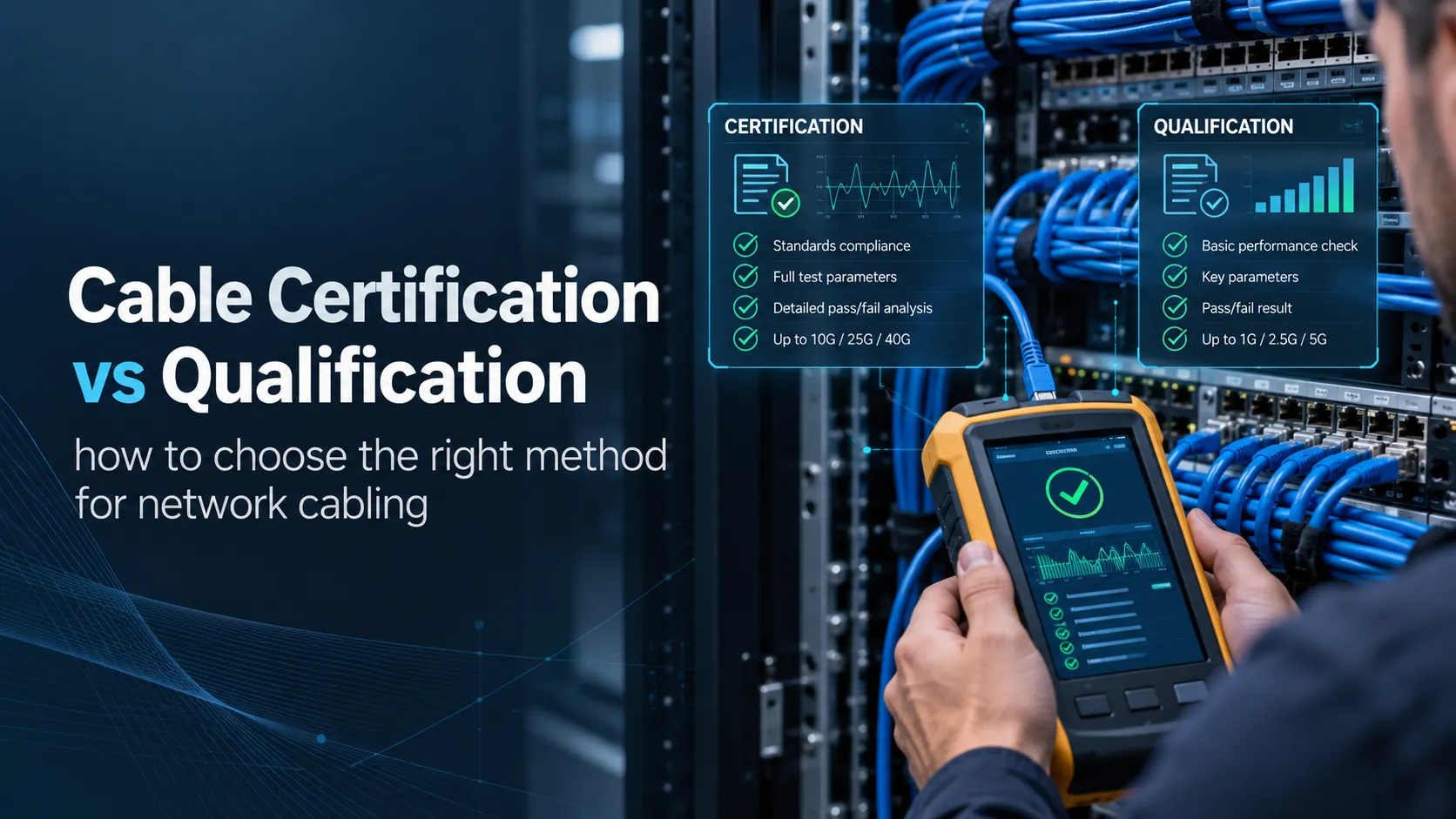
A network cable can look completely fine on the surface and still be the root cause of slow speeds and random drops. The link light turns green, the computer gets an IP address and a basic pinout test shows all eight wires are connected properly. Yet the moment you upgrade from 1GbE to 10GbE, plug in a new high-speed Wi-Fi access point or start pushing power over Ethernet (PoE), everything falls apart. So, the real issue usually isn’t whether the cable is plugged in. It’s whether you’ve tested it thoroughly enough for what you’re asking it to do.
This is where understanding the differences between verification, qualification and certification becomes essential. If you’re an IT admin fixing a connection at someone’s desk, running a full standard certification test is overkill. But if you’re a cable contractor handing over hundreds of brand-new Cat6A runs, a basic qualification test won’t cut it for project sign-offs or manufacturer warranty claims. Knowing how Cable Certification vs Qualification works keeps you from wasting money on unnecessary testing or accepting a job without proof that the installation was done right. Simply put: choose the test that actually answers your question.
Verification, Qualification and Certification
The easiest way to understand network testing is to think of it in three levels. Verification asks: “Is this cable wired correctly?” A quick verification check looks at the basics wiremaps, splits, short circuits and rough cable lengths to pinpoint broken connections. It’s your go to move when troubleshooting. If a desk loses connection out of nowhere, IT just needs to know if a physical wire broke or a connector slipped out. That said, verification won’t tell you if a Cat6A cable can actually hit Cat6A speeds.
Qualification asks: “What speed can this line actually handle?” Qualification digs deeper, confirming whether existing wiring can handle real-world demands like 1GbE, 2.5GbE, 5GbE or 10GbE. Take AEM’s Network Service Assistant, for instance. It operates as a Qualification+ tool, slotting right between basic qualification and full on certification. Its Certi-Lite features run measurements normally reserved for deep diagnostics, while its Multi-Gig capabilities test actual Ethernet performance all the way up to 10GbE. This makes qualification ideal when you’re looking to upgrade network speeds over existing wiring without replacing everything.
Certification asks: “Does this line strictly meet industry standards?” Cable certifiers evaluate detailed physical parameters against set regulatory limits, delivering an official, standardized pass or fail rating. With tools like AEM’s TestPro CV100, technicians can select profiles like TIA Cat6A Channel and run complete diagnostic suites. AEM even notes that its full Cat6A Autotest wraps up in about six seconds. That distinction is at the heart of Cable Certification vs Qualification.
Qualification proves that a line can run the specific app or bandwidth you need today. Certification delivers concrete, documented proof that the installation meets rigorous category performance benchmarks for the long haul.
What Each Test Can Prove
When comparing Cable Certification vs Qualification, each testing method answers a completely different question, which is why substituting one for another usually backfires.
| Test level | Main question | Typical outcome | Best fit |
| Verification | Is the cable physically connected correctly? | Wiremap, open/short, basic fault information | Troubleshooting and installation checks |
| Qualification | Which Ethernet applications can this link support? | Supported speed, SNR/headroom and application suitability | Existing-network upgrades and IT maintenance |
| Certification | Does the link comply with the selected cabling standard? | Standards-based PASS/FAIL with detailed measurements | New installation acceptance, formal handover and specified warranty programmes |
Imagine an organization planning to hook up a new Wi-Fi access point to a Cat6 link installed years ago. There is no real need for IT to re-verify whether that decade old cabling meets every single original Cat6 specification. Their immediate question is much simpler:
Can this cable reliably handle a 2.5G or 5G connection today? As AEM notes in its Ethernet performance testing guide, tools like the TestPro and Network Service Assistant can evaluate links directly against specific Ethernet speeds while tracking signal-to-noise ratios and worst-case margins.
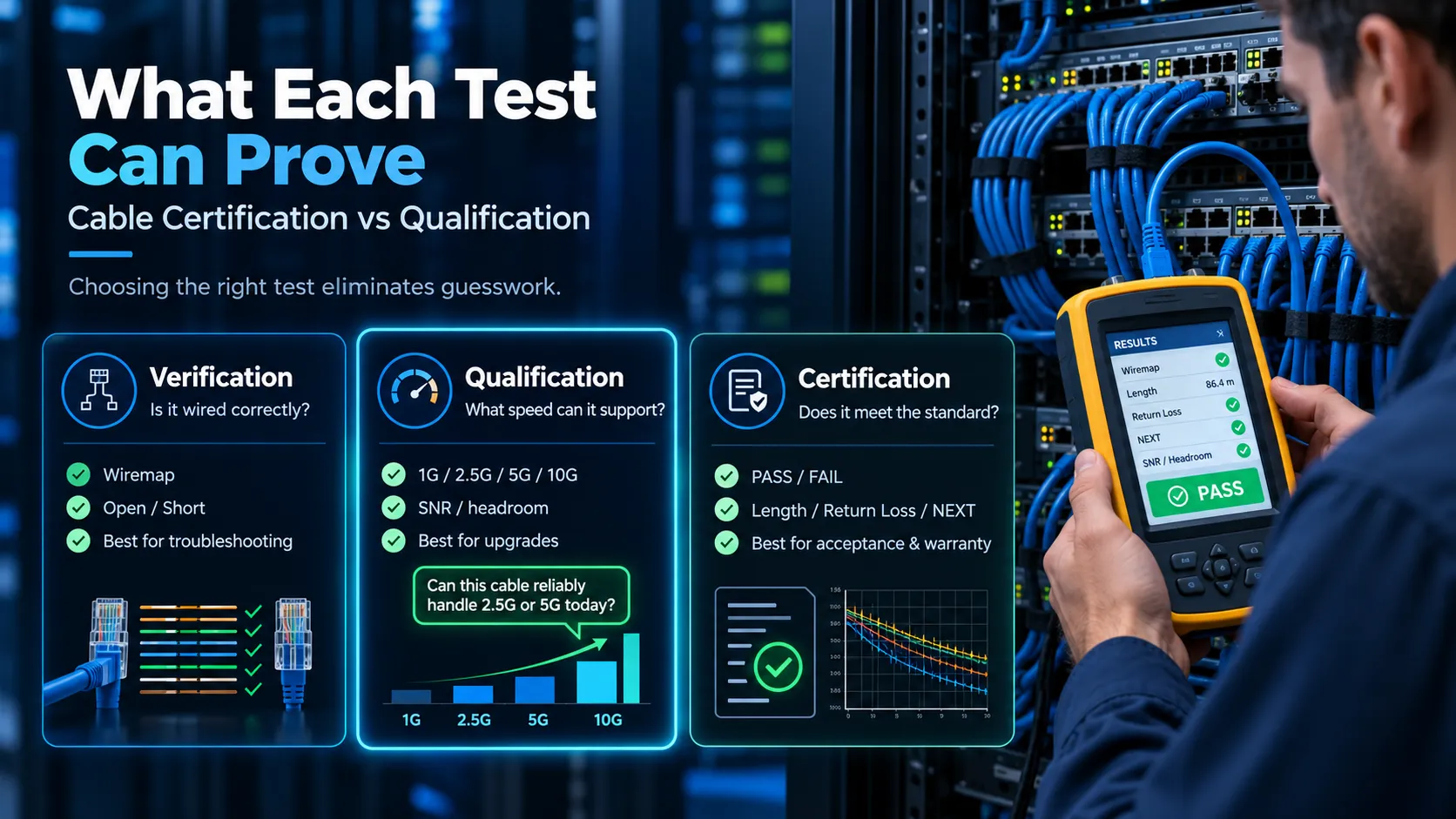
Multi Gig testing can cycle through 100 Mbps, 1G, 2.5G, 5G and 10G speeds to verify real-world throughput. Certification, however, tackles a totally different challenge. Rather than just checking if a specific app runs, certification measures exact electrical parameters required by formal cabling standards.
Using AEM’s TestPro workflow, for example, technicians measure key physical attributes like length, insertion loss, return loss and NEXT to evaluate the infrastructure against strict industry criteria. This Cable Certification vs Qualification distinction is critical when handing off a finished project.
Just because a 10GbE connection connects today doesn’t guarantee the installation meets true Cat6A standards. On the flip side, having a fully certified Cat6A link doesn’t mean every future connection problem will be a cabling issue, switches, network configurations, endpoints and software can still cause trouble. Ultimately, proper testing eliminates guesswork where it counts.
When Certification Is Required
In the Cable Certification vs Qualification decision, certification makes the most sense when the cable itself is a main part of what you’re delivering. Think about setting up a brand-new corporate headquarters, for instance. The client asked for Cat6A structured cabling across several floors, meaning hundreds or even thousands of lines will soon disappear behind drywalls and above ceiling tiles once construction wraps up. When it’s time for handover, simply saying “every device plugged in just fine” isn’t going to be enough proof.
Clients want real, documented proof that every single run passed its required testing limits when accepted. That’s where the Telecommunications Industry Association’s ANSI/TIA-1152-A standard comes in, it defines performance and accuracy rules for field test gear used on twisted-pair cabling. TIA was still actively reaffirming this standard in 2026, showing just how essential controlled, standardized measurements remain in modern cabling projects.
Because of this, certification is pretty much standard practice for new cabling installs, major office revamps, data centers, enterprise campuses or any project where category or class compliance is explicitly required. It is also valuable when the infrastructure is expected to remain in service for many years. A formal test record provides a baseline against which later faults or changes can be compared.
Installation Acceptance and Warranty
Cable Certification vs Qualification also matters when you need to hand over official test results to wrap up a project or qualify for a manufacturer’s warranty. Many cabling vendors won’t issue extended system warranties unless you test with approved gear, stick to specific limits and submit clean, saved test files.
Since these rules vary depending on the manufacturer and product line, it’s always best to double-check them before starting. For instance, AEM keeps an updated list of manufacturers that approve TestPro for certification. This goes to show that picking the right tester isn’t just about technical features it’s often tied directly to warranty requirements. That’s something contractors should definitely nail down before getting to the final sign off stage.
If a client expects a manufacturer backed warranty, finding out at the end that your test results don’t qualify can mean expensive retesting across the entire site. To avoid surprises, make sure your project specs clearly outline the cabling standards, test limits, link models, reporting formats and vendor warranty rules before anyone plugs in a tester.
Permanent Link vs Channel Testing
Even when Cable Certification vs Qualification points toward certification, your team still needs to pick the right test setup. A permanent link test only checks the fixed cabling running between the patch panel and the wall outlet. It leaves out the equipment patch cords you plugin later on. A channel test covers the whole line, including those patch cords on both ends, giving you a full end-to-end view of the connection.
Because you are measuring two different setups, each test relies on its own performance limits. AEM’s TestPro guide points out the difference between permanent-link and channel adapters, highlighting why you need to choose the right interface and limits for the specific line you’re testing.
Modern smart buildings have brought another setup into the mix: the Modular Plug Terminated Link (MPTL). Devices like IP cameras and Wi-Fi access points often have built-in RJ45 ports, so installers plug the horizontal cable directly into the device using a modular plug instead of a standard wall jack.
According to AEM’s MPTL testing guide, an MPTL is basically a permanent link with a field terminated plug on one end. To certify it correctly, you’ll need the right permanent-link adapter, category specific patch cord adapters and the appropriate MPTL test limit. All of this goes to show why simply stating “we tested the cable” leaves out most of the story. How it was tested matters.
When Qualification Is Enough
The Cable Certification vs Qualification choice does not always end with certification. Certification is powerful, but let’s be real not every job requires a full formal sign-off. Picture a company swapping out its switches and upgrading speed from 1GbE to 2.5GbE at everyone’s desk. The cables have been sitting in the walls for years. Nobody needs a brand new warranty; management just wants to know if the current lines can handle the faster speed.
That’s where cable qualification shines as the more practical choice in Cable Certification vs Qualification. Instead of certifying every link from the beginning, IT can evaluate whether the installed cables deliver sufficient performance for the applications they intend to run. The same applies when troubleshooting. If one access point stalls at 1GbE while the others run smoothly at 5GbE, you don’t need to dig up the original installer’s test certificate. You just need to know if that specific link has the signal quality and headroom to push 5GbE right now.
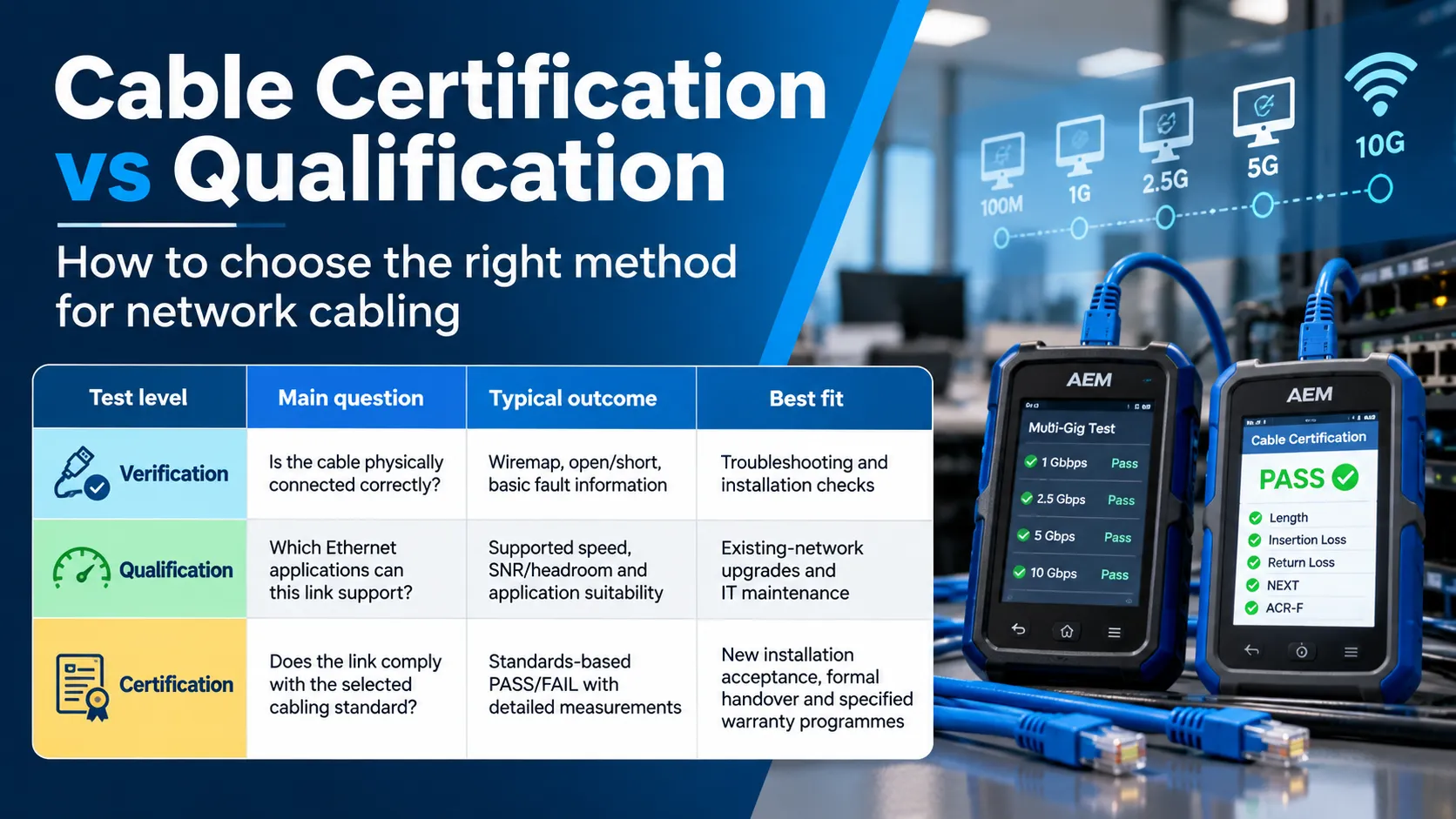
Take AEM’s Certi-Lite Qualification+ approach, for example. It goes well beyond simple pinout checks by running single ended diagnostics normally reserved for full certifiers, while testing real-world Multi-Gig capabilities directly on the line. This makes qualification a great fit for internal IT teams dealing with office moves, routine troubleshooting, speed upgrades or reusing existing infrastructure. It is not “bad certification.” It is a different test designed to answer a different operational question.
How to Read a Pass or Fail Report
When you get a test report back, don’t just look for a big green “PASS” at the top and call it a day Start by checking the actual test profile. Was this Cat6 or Cat6A? Permanent Link or Channel? Which TIA or ISO limit was selected? Was the correct cable category entered? A pass against the wrong profile proves very little. Then look at the margin.
A cable might technically pass while scraping by right at the limit. That’s a problem because real world environments aren’t perfect control labs cabling ages, patch cables get swapped and temperatures change. As AEM points out in their guide on PASS* and marginal results, an asterisk appears when a measurement lands right inside the tester’s margin of uncertainty.
Rather than assuming the link is perfectly healthy just because it says “pass,” it’s smarter to treat marginal results as warning signs and inspect the line. If a certification test fails, the specific metric that failed will point you right to the culprit. Wiremap errors usually mean bad terminations or broken conductors. High insertion loss points toward excessive cable lengths, damaged wiring, or loose connections. Meanwhile, NEXT failures typically stem from poor termination quality, untwisted pairs, or crosstalk issues.
Tools like the AEM TestPro feature diagnostic utilities like NEXT Locator and Return Loss Locator to pinpoint exactly where along the run the fault is happening. Finally, don’t forget to save and organize your test results properly. These reports aren’t just for day one troubleshooting, they serve as proof of completion for client sign offs, warranty verification and a historical baseline for future network upgrades.
With platforms like AEM’s TestDataPro Cloud, you can upload field results to a centralized database, review pass/fail statuses and generate professional PDF reports. That turns routine testing into valuable, long term documentation your business can rely on down the road.
Choosing the Right Test Kit
When picking a test tool, the Cable Certification vs Qualification choice should start by looking at what your team actually does day in and day out. If you’re a structured cabling contractor installing fresh Cat6A or higher spec infrastructure, you’ll need a genuine cable certifier that delivers standards compliant results and clean, professional reports for client handovers.
That’s where tools like AEM’s TestPro CV100 come in. Built for copper and fiber certification across enterprise, data center and smart building projects, it handles Cat3 right up through Cat8 while tying into AEM’s full reporting ecosystem.
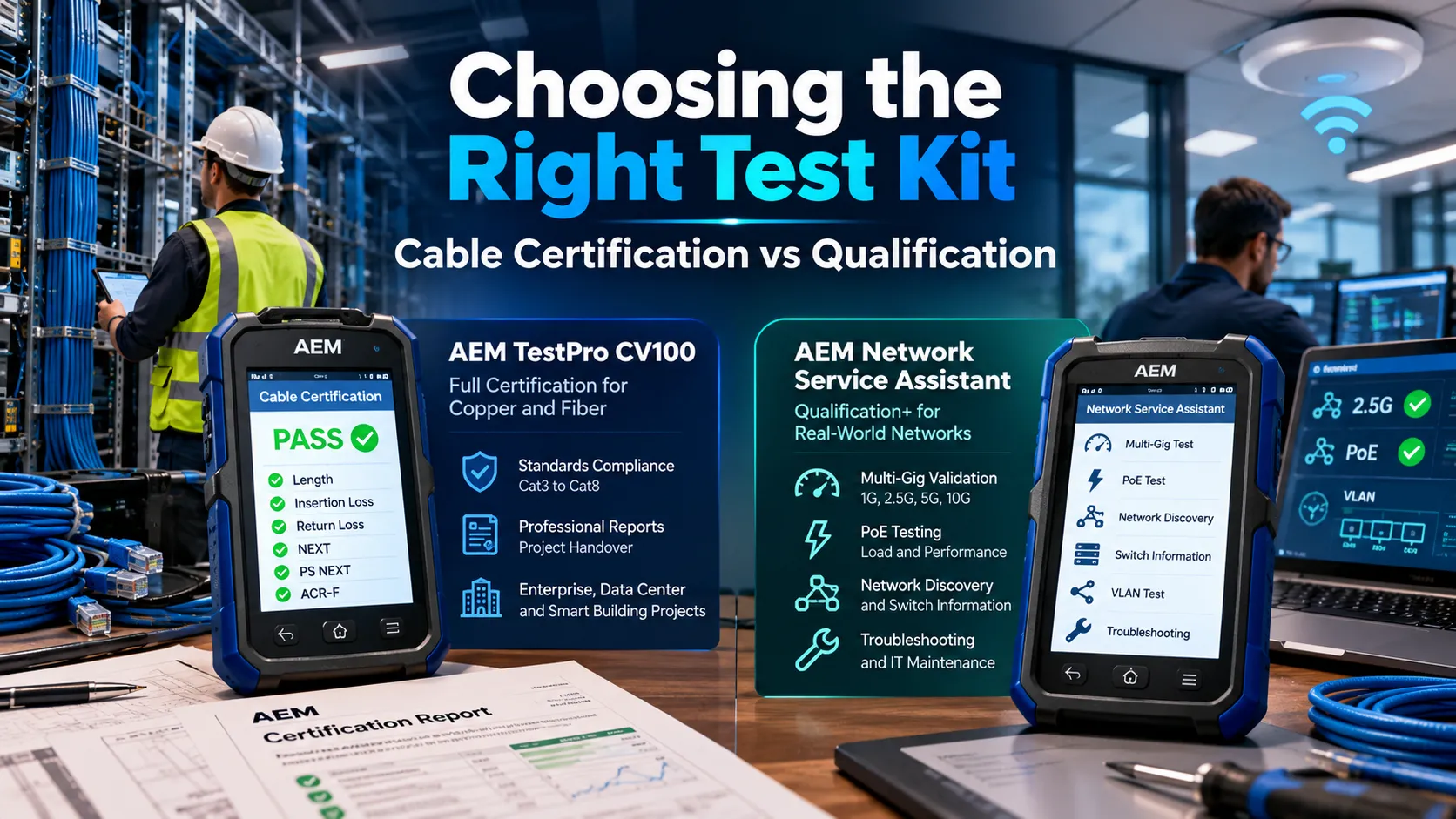
Internal IT teams, on the other hand, usually tackle very different daily challenges. Instead of running certification suites, they’re typically figuring out if existing runs can handle Multi-Gig speeds, checking whether an access point is drawing enough PoE, verifying VLAN setups or troubleshooting connection drops. For those scenarios, AEM’s Network Service Assistant combines Qualification+ testing with handy features like Multi-Gig validation, PoE checks, network discovery, switch information and general network troubleshooting.
That exact division of needs is why D3, an AEM Distributor in Dubai and the GCC, features both tools side by side. D3’s value is not simply supplying a tester. It is helping contractors, system integrators and enterprise IT teams identify what they actually need to prove. If you’re handing over a brand new structured cabling project, formal standards based certification is a must.
If you’re simply checking whether older wiring can support 2.5G, 5G or 10G speeds after a refresh, qualification gets you the answers you need faster and without extra expense. And if all you need to know is whether somebody terminated pairs 4 and 5 incorrectly, basic verification may be enough.
Ultimately, Cable Certification vs Qualification is about matching the test to the risk. Because there is a major difference between saying “the cable works”, “the cable supports 10GbE” and “the installed link meets the Cat6A certification limit.” A professional network team should know exactly which of those statements it needs to prove.