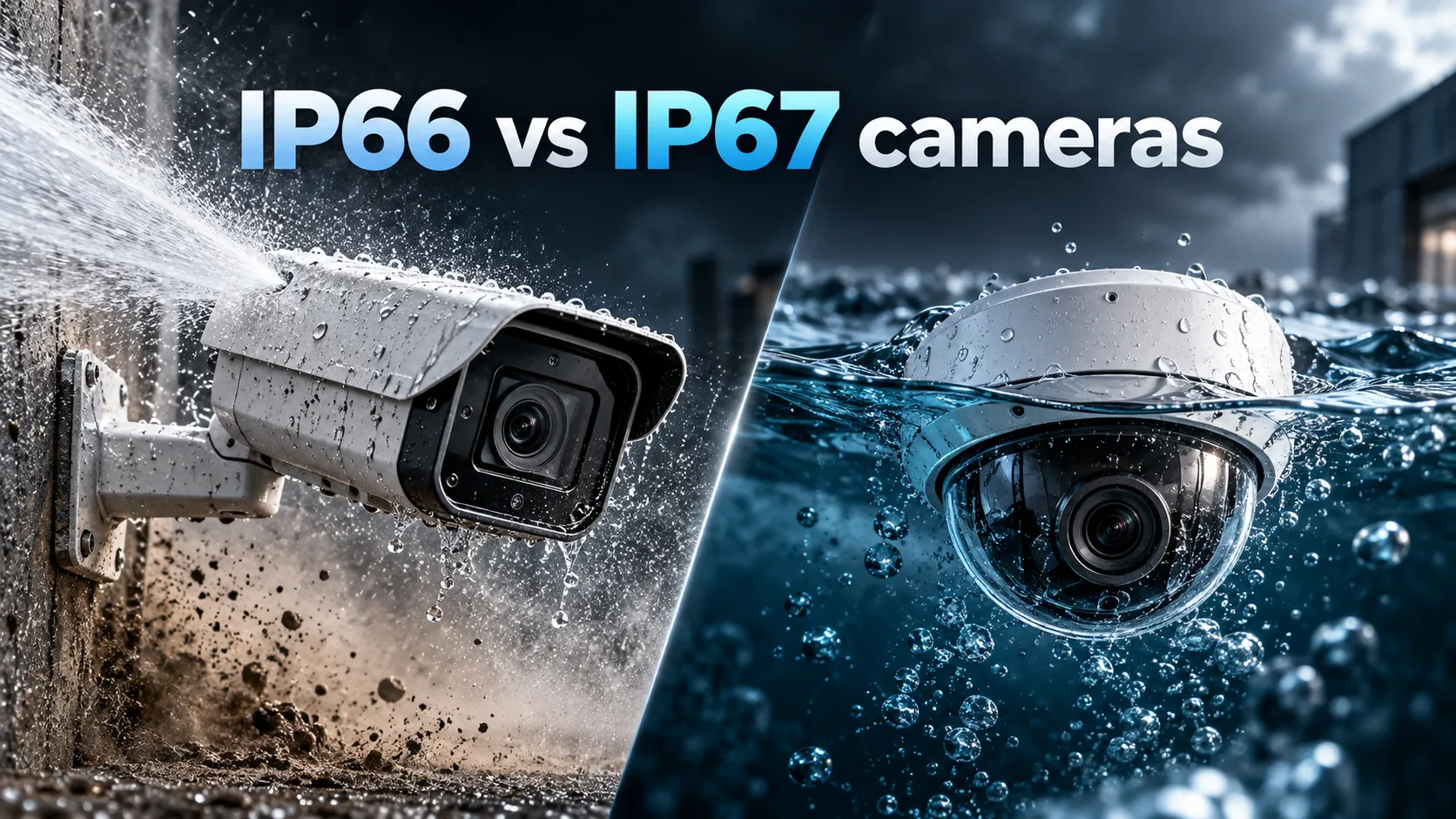
When you look at outdoor CCTV specs, you’ll constantly run into labels like IP66, IP67 and IK10. They sound impressive and give you peace of mind at first glance. Most people take them as a simple green light that a camera is ready for the outdoors, but that’s oversimplifying things.
Take an IP67 camera, for example: it might handle temporary immersion, but if its operating temperature isn’t built for intense Persian Gulf sunshine, it’s going to struggle. Similarly, an IK10 dome camera can take a heavy blow, but if the installer leaves a cable gland exposed, water can still seep into the junction box. That is why IP66 vs IP67 cameras should be compared by the water exposure they face, not by whichever number looks higher.
Each rating is designed to answer a very specific question.
Simply put, IP ratings measure how well a camera body keeps out solids like dust and water, while IK ratings measure how much physical impact it can take. These classifications are defined by IEC 60529 (for IP protection) and IEC 62262 (for IK impact protection).
For surveillance projects across the GCC, understanding what these codes do—and, just as importantly, what they do not cover—helps integrators avoid specifying a camera by one line in the datasheet while ignoring the environment around it.
The correct outdoor camera is not the one with the biggest-looking protection code. It’s the one where the casing, temperature limits, mounting setup and accessories all work together to fit the specific needs of the site.
What an IP Rating Measures
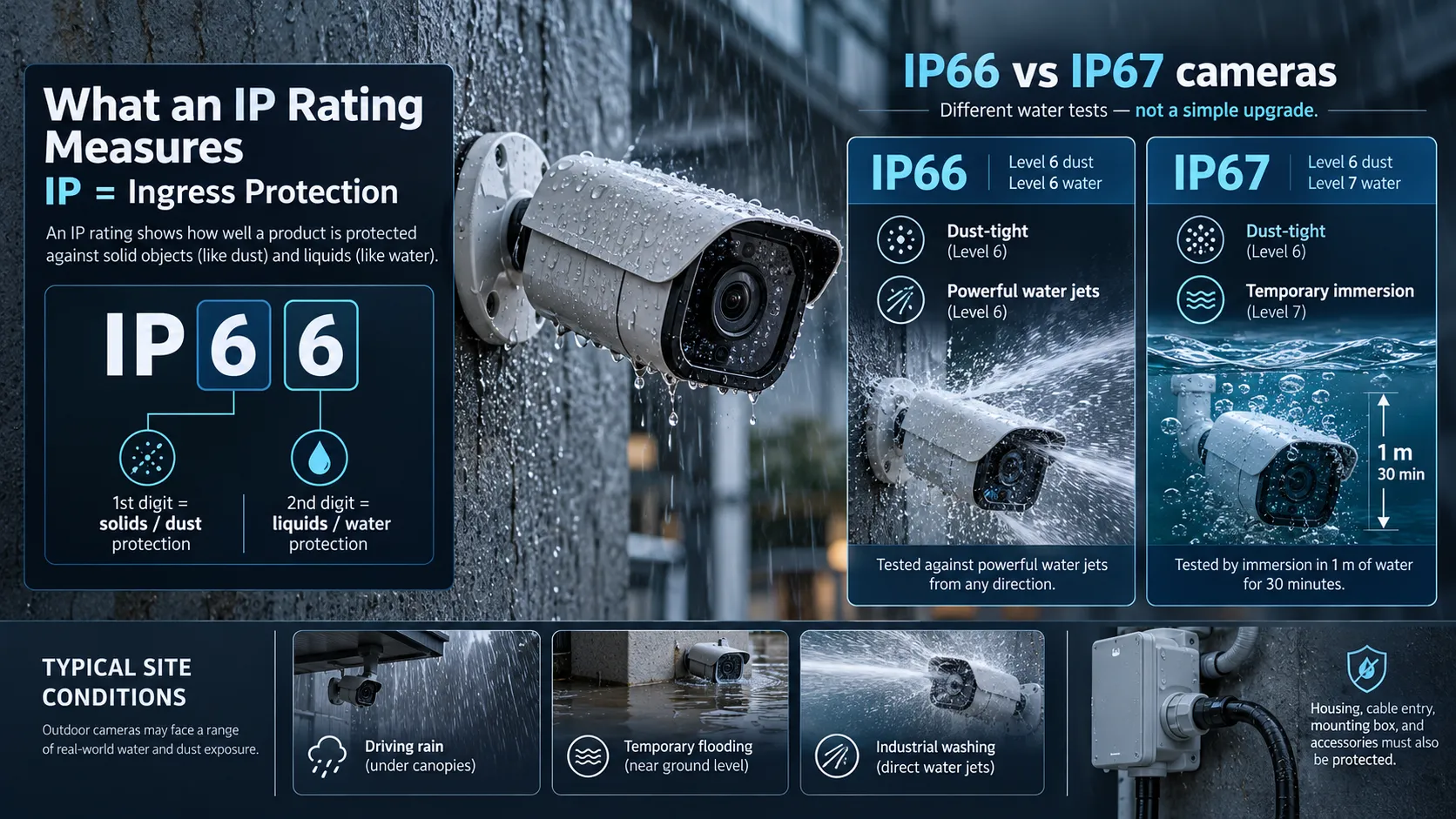
IP stands for Ingress Protection. You’ll almost always see it written as a two-digit code.
The first digit tells you how well it keeps out solids like dust, while the second digit covers protection against liquids.
With outdoor security cameras rated IP66 or IP67, that first number is a 6. That’s the highest level for solid ingress, meaning the housing is dust-tight. When comparing IP66 vs IP67 cameras, the distinction lies in the second digit and the water test it represents.
Here’s a quick way to think about it:
- IP66 = level 6 dust protection + level 6 water protection
- IP67 = level 6 dust protection + level 7 water protection
Keep in mind, the IEC 60529 IP Code standard defines these as enclosure protection ratings rather than a broad guarantee of a camera’s overall durability.
That distinction matters more than you might think.
An IP rating only measures how well the casing seals against intrusion under specific laboratory conditions. It won’t tell you how well the camera withstands physical vandalism, harsh sunlight, salt corrosion, severe vibrations, blistering heat or a poor installation job. These ratings also assume the unit is installed perfectly. If an installer forgets a cable seal, drills an unapproved hole or uses an incompatible junction box, all those lab certs won’t stop water from leaking in.
That’s why looking at the entire setup is so crucial. The housing may be IP67. The cable connection, mounting box and accessories need protection too.
IP66 vs IP67 cameras: Different Water Tests
One of the most common misunderstandings is that IP67 simply means “better than IP66.”
The truth is more specific.
IP66 and IP67 represent different water tests.
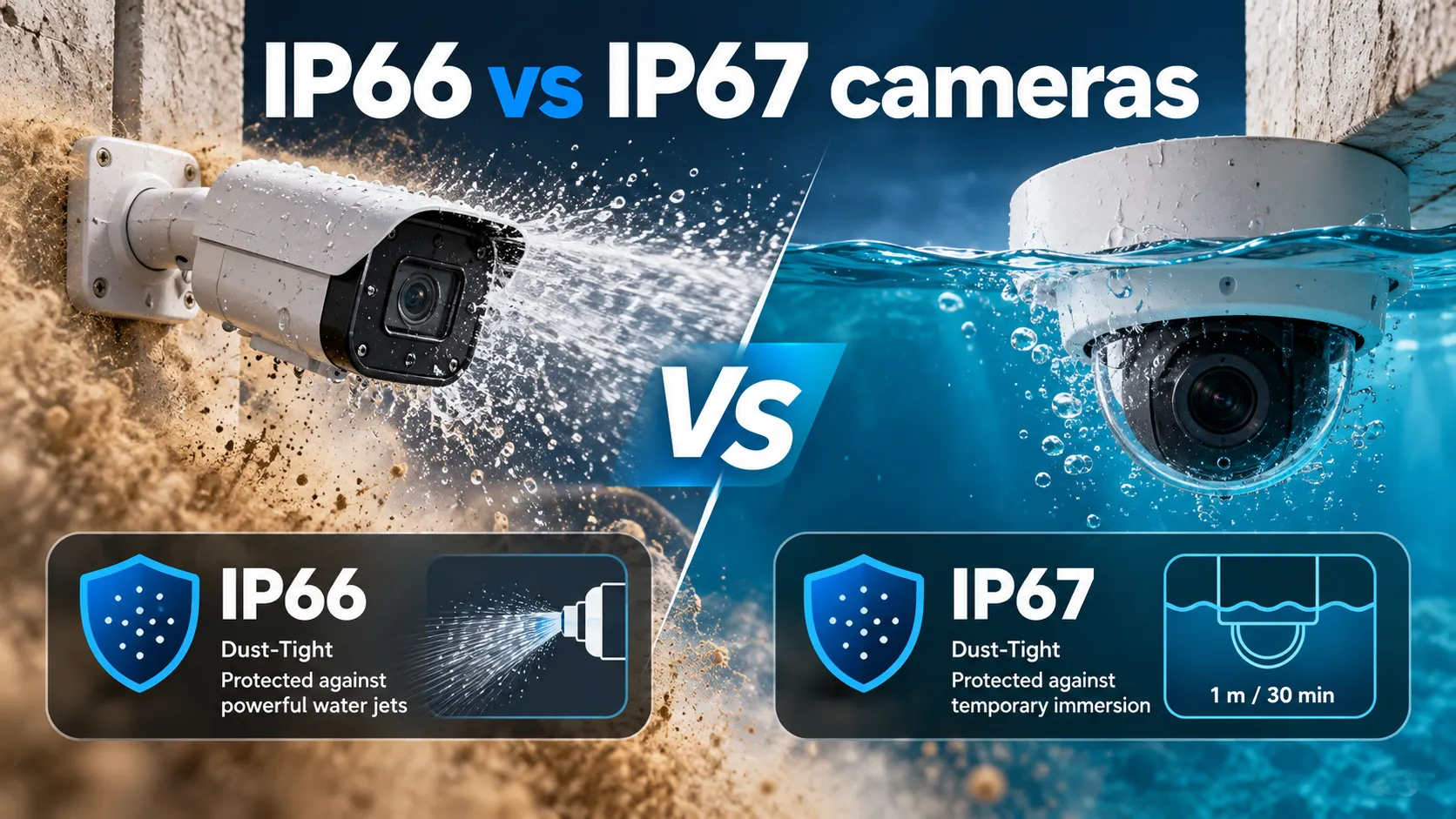
IP66 is designed around resistance to powerful water jets. Axis describes an IP66 enclosure as dust-tight and protected against powerful water jets. Its product-testing documentation describes a demanding jet test in which exposed surfaces are subjected to high-flow water from different angles before the enclosure is inspected for ingress.
That type of rating is relevant for cameras exposed to heavy rain, wind-driven water or cleaning conditions where water may strike the housing from different directions.
IP67 tests something different: temporary immersion.
A typical IEC 60529 IP67 implementation is tested with the enclosure immersed approximately one metre in water for around 30 minutes under the specified conditions. Phoenix Contact, for example, lists its IP67 test condition as 1 m / 30 min for products tested to the IEC-based standard.
That does not mean an IP67 surveillance camera should be treated as underwater equipment.
It means the enclosure has passed a defined immersion test.
More importantly, passing IP67 does not automatically prove that the exact same product has also passed the IP66 jet test. Axis notes that the IP66 water-pressure test can actually be harsher in one respect than the IP67 immersion test and warns against reading the numbers as a simple durability ranking. The key to choosing IP66 vs IP67 cameras is understanding which of these distinct tests applies to your site.
For a real surveillance project, this gives specification teams a better question:
What type of water exposure is likely at this location?
A camera under an exposed warehouse canopy may face driving rain.
A camera close to ground level may occasionally encounter temporary flooding.
A camera installed in an industrial washing area may experience direct water jets.
Those environments are different, even if somebody simply writes “outdoor camera” on the project requirement. For IP66 vs IP67 cameras in these settings, ask which water tests the exact model has passed rather than assuming one label covers both.
What IK10 Says About Impact Resistance
While IP ratings cover ingress protection, IK ratings focus strictly on impact resistance. IK standardizes how much impact energy a housing can withstand in a defined test. The IK rating system comes from IEC 62262, which measures how well an enclosure withstands external mechanical impacts. When evaluating IP66 vs IP67 cameras for accessible locations, IK10 answers a different question from either IP rating.
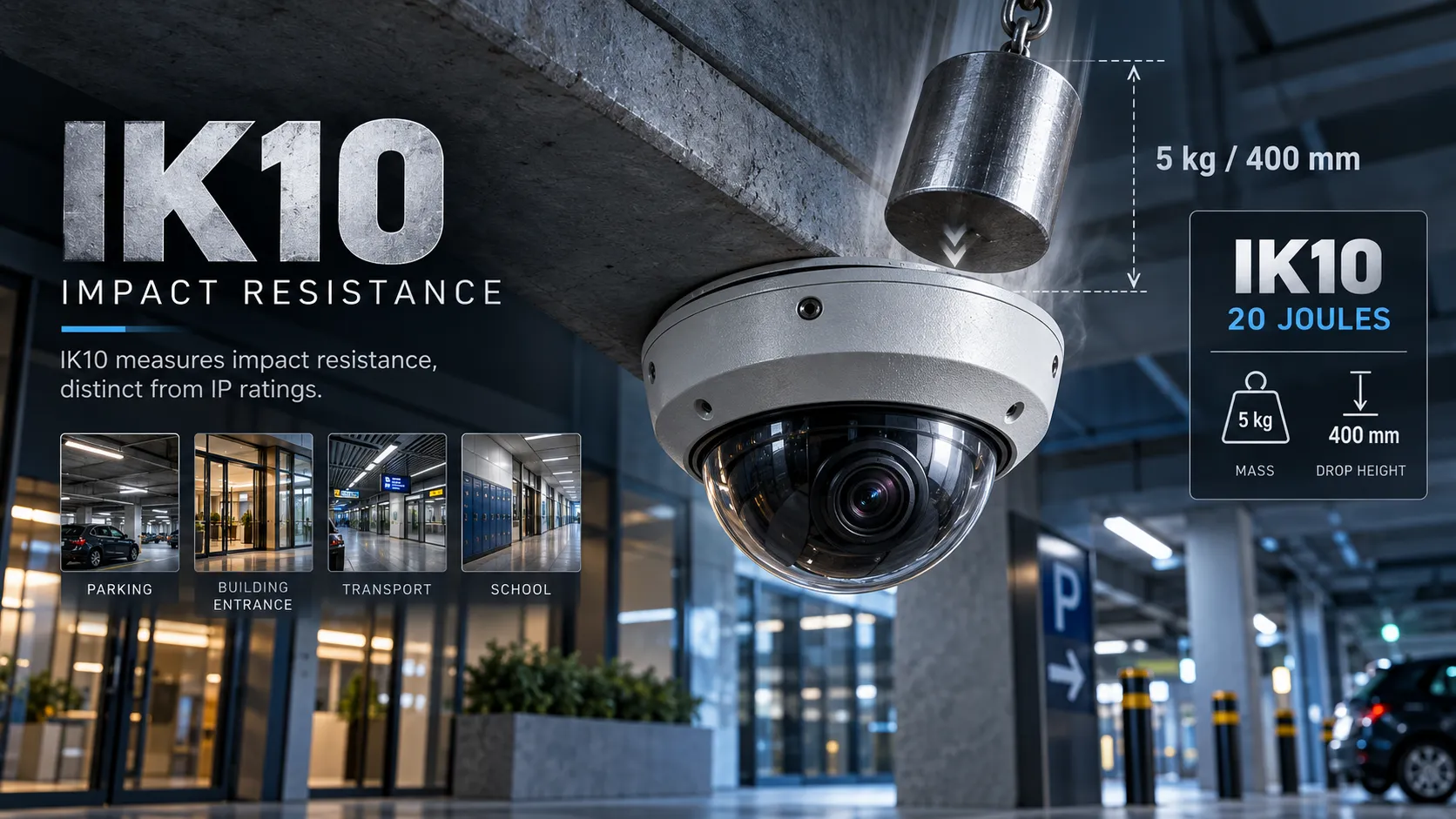
An IK10 rating specifically indicates protection against 20 joules of impact energy.
In practical terms, the same impact energy can be illustrated by a 5 kg mass falling from a height of 400 mm. Axis uses these parameters when explaining IK10 in its technical documentation. This becomes critical for security cameras installed in places within easy physical reach:
- Low ceilings in parking facilities
- Building entrances
- Public corridors
- Schools and universities
- Retail environments
- Transport facilities
- Industrial sites
- Accessible perimeter installations
While manufacturers often market a high IK rating as “vandal-proof,” it’s worth looking at what that label actually covers. IK10 proves a camera passed a very specific, standardized impact test.
It doesn’t mean the camera is completely indestructible. Sustained attacks, heavy tools, prying forces or damage to the mounting structure can all exceed what the IK test measures. How it’s mounted matters just as much: a tough dome camera on a flimsy ceiling tile won’t offer much real protection.
Both AEROSKOP and Tiandy offer options built for tough settings. For instance, D3 highlights AEROSKOP IP67 / IK10 housings for demanding surveillance setups, while select Tiandy models feature rugged metal bodies backed by both IP67 and IK10 ratings.
What These Ratings Do Not Cover
IP and IK are useful because they give buyers standardised information.
They are dangerous when buyers assume they answer every environmental question.
They do not.
An IP67 / IK10 camera can still be a poor choice for a particular site if its operating temperature, mounting system, material, accessories or electrical protection are wrong. Comparing IP66 vs IP67 cameras therefore requires more than checking their enclosure ratings.
Axis makes this point directly in its outdoor-equipment guidance: an IP rating alone does not prove that a camera is suitable for every outdoor environment. Other conditions, including temperature, humidity and UV exposure, also need to be considered.
Heat, Sunlight and Corrosion
In many GCC installations, heat is an obvious factor you can’t ignore. When you install a camera outdoors in places like Dubai, Riyadh or an industrial site, it faces conditions far harsher than any air-conditioned office. For IP66 vs IP67 cameras in these environments, the operating temperature range on the datasheet should be a top priority, not an afterthought.
Some outdoor Tiandy models are built to operate from -35°C to +65°C alongside IP67 and IK10 ratings. That whole package gives you a much clearer picture than looking at the enclosure rating by itself, as it connects physical toughness with real-world temperature limits. Always check the range for the specific model.
Direct sunlight creates another problem. The local temperature around a dark camera housing exposed to the sun can differ considerably from the published ambient weather temperature. UV radiation can also affect plastics, seals and coatings over time if those materials are not intended for outdoor exposure.
Corrosion is another separate issue. An IP rating tells you about water ingress. It does not necessarily demonstrate long-term resistance to saline air or corrosive environments.
A camera installed at a coastal resort, seaport, industrial plant or chemical-processing facility may need housing materials or coatings tested specifically for corrosion. That is why “IP67” should not be translated into “safe for every harsh environment.” It is one piece of the environmental specification.
Condensation and Cable Entries
Water inside a camera isn’t always from rain sneaking through the body. Often, simple condensation is the real culprit. When temperature and humidity swing between day and night, warm, moist air trapped inside poorly sealed housings or boxes can cool down and form droplets. Even a careful comparison of IP66 vs IP67 cameras won’t solve moisture problems caused by the surrounding installation.
Cable pathways can also act as unintended channels for moisture. Without proper drip loops, glands or conduit setups, an outdoor Ethernet cable can channel water right into the camera or junction box. Placing a connection box above the camera makes it even easier for water to run straight down the line. Because of this, the biggest vulnerability is frequently the cable entry rather than the camera housing itself.
Using outdoor-rated cable glands, proper conduit adapters and sealed junction boxes helps keep the connection points protected. For example, Tiandy offers IP66/IP67 cable glands, and Axis offers IP66/IP67 conduit back boxes designed to protect cable entry points when installed correctly. At the end of the day, a perfectly sealed camera connected to an unsealed box leaves your security setup exposed.
Match Protection to the Site
At the end of the day, you should pick a rating based on where the camera is actually going. If you’re just putting a camera in a climate-controlled indoor hallway, paying extra for heavy-duty ingress protection doesn’t make much sense.
On the other hand, an outdoor shipping yard calls for suitable water and dust protection. For teams comparing IP66 vs IP67 cameras at such a site, the decision depends on whether jet exposure, temporary immersion or both must be covered. If you’re mounting cameras within arm’s reach in a parking garage, physical impact resistance like IK10 becomes just as crucial. And for coastal industrial sites, you can’t stop at dust and impact ratings; you’ll need corrosion-resistant materials and the right operating temperature specs too.
When setting up remote infrastructure in the GCC region, where cameras face blistering heat, swirling dust and nonstop outdoor exposure, you have to look at the whole environmental picture instead of relying on a single code on a datasheet.
That’s why D3 works as an AEROSKOP Distributor for industrial and harsh-environment surveillance projects. Its portfolio highlights IP67 / IK10 housings for industrial facilities, logistics hubs, outdoor yards and critical infrastructure where equipment needs to operate reliably under tough regional conditions.
Similarly, as a Tiandy Distributor, D3 supports perimeter security, remote sites, and specialized camera setups across GCC environments. Ultimately, the rating should match the installation spot, not the other way around.
Check the Housing and Accessories
When choosing an outdoor camera, you need to look at everything attached to it, not just the unit itself.
Start by looking at the camera body material and whether the dome or front window is built to resist impacts. Then check the mounting bracket and junction box. Verify that all cable glands and seals are fitted correctly, and make sure unused cable entries are closed off. Finally, confirm that the chosen accessories won’t compromise the camera’s IP or IK ratings.
A camera might carry an IP67 rating, but using an incompatible mount can easily leave cabling exposed to the elements. Similarly, an IK10 dome can withstand heavy impacts, but it won’t help much if the mounting arm is weak enough to be twisted or ripped away.
In exposed locations, surge protection and proper grounding are also essential. Neither IP67 nor IK10 will protect the Ethernet port from an electrical surge caused by outdoor wiring or nearby lightning strikes. Ultimately, you should evaluate the setup as a complete installed system rather than relying on a standalone spec sheet. This is where integrators add value: matching camera, mount, enclosure, cable route, PoE infrastructure and site conditions before installation begins.
An Outdoor Camera Specification Checklist
Before giving final approval for an outdoor CCTV camera, use this IP66 vs IP67 cameras specification checklist to confirm the complete installation is suitable for the site:
- IP rating: Does it handle the site’s expected dust and water exposure?
- Water condition: Does the site mainly face rain and water jets, temporary immersion risk, or something more demanding?
- IK requirement: Is the camera within easy physical reach or vulnerable to deliberate strikes?
- Operating temperature: Does the stated temperature rating cover extreme real-world weather on site?
- Direct sunlight: Is the housing suitable for continuous outdoor and UV exposure?
- Corrosion risk: Is the installation located in a coastal, industrial or chemically aggressive environment?
- Housing material: Is the enclosure construction appropriate for the installation?
- Cable entries: Are all glands, conduits, and junction boxes properly rated and sealed?
- Accessories: Do the chosen mounts and back boxes preserve the camera’s protective rating?
- Condensation: Has the installation been designed to prevent moisture accumulation?
- Electrical protection: Have grounding, surge protection and outdoor PoE needs been accounted for?
- Camera placement: Can smart positioning shield the camera from heavy rain, direct glare or physical tamper risk?
- Maintenance access: Can technicians inspect seals and cabling down the road without damaging the weather seal?
- Image performance: Has the camera been tested on site across day, night, dusty air and tricky lighting rather than picked solely for its housing code?
- Complete installation review: Does full environmental protection remain intact once the camera, cables, bracket, and junction box are fully assembled?
Ratings like IP66, IP67 and IK10 are incredibly useful because they replace vague marketing terms like “weatherproof” or “vandal-resistant” with clear, standardized test benchmarks.
However, they only add value when interpreted properly.
IP66 tells you about dust and powerful water jets. IP67 tells you about dust and temporary immersion. IK10 tells you about resistance to a defined 20-joule mechanical impact. None of them tells you everything about surviving outdoors.
For enterprise security projects across the GCC, D3 combines AEROSKOP surveillance hardware and Tiandy’s IP camera lineup with regional deployment consultation and technical support.
A solid project specification goes beyond simply asking:
“Is this camera IP67 and IK10?”
It focuses on the bigger question:
“Will the entire installed camera system survive the actual environment we are putting it into?”