A good UPS can easily outlast the batteries driving it. That distinction is crucial, given that batteries represent one of the most critical and regularly swapped components in any backup power setup.
For years, VRLA batteries were the default option for UPS power. They are familiar, easy to find, and won’t break the bank upfront. However, lithium-ion technology has completely shifted the landscape. With longer lifespans, smaller footprints, lighter weights, and smarter monitoring, lithium-ion is an appealing choice for companies looking to minimize replacement headaches. That does not mean lithium-ion is automatically the correct choice.
If you’re simply swapping out old batteries in an existing UPS, sticking with VRLA might be the easiest and cheapest option. On the flip side, a brand-new server room short on floor space might lean toward lithium-ion. Meanwhile, a major data center planning out its ten-year budget will want to focus on total lifecycle costs rather than just the initial price tag.
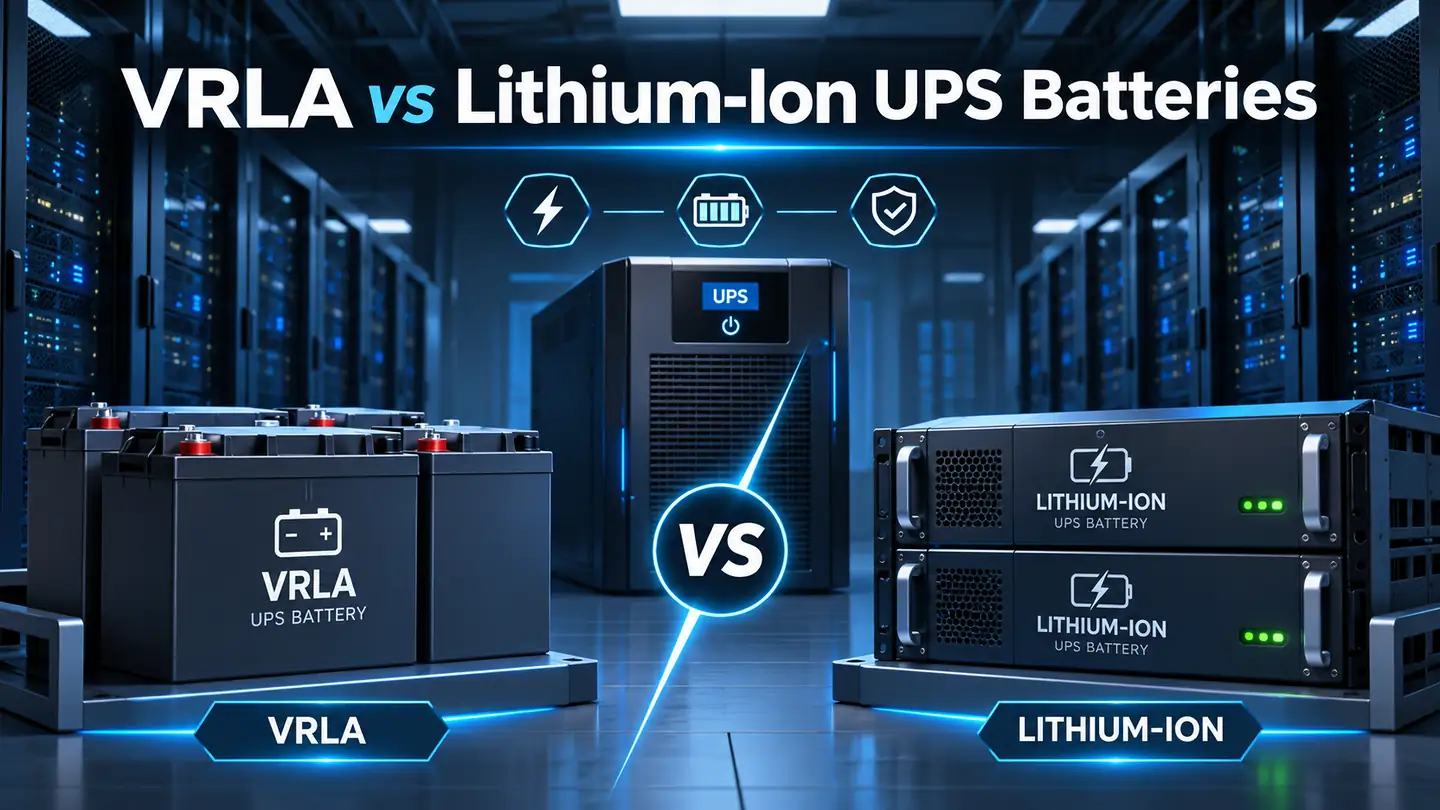
So when weighing VRLA vs Lithium-Ion UPS Batteries, the real question isn’t:
“Which battery technology is better?”
It is:
“Which option best aligns with our specific UPS setup, runtime needs, operating environment, maintenance strategy, and overall system lifetime?”
VRLA and Lithium-Ion Batteries Explained
VRLA stands for Valve-Regulated Lead-Acid.
In a VRLA vs Lithium-Ion UPS Batteries comparison, VRLA is a tried and true sealed lead-acid technology that has been the go to choice for UPS systems for years because of its straightforward reliability, familiarity, and widespread support.
Unlike older flooded lead acid batteries, you won’t need to top them off with water. Depending on your system’s setup, they neatly fit into standard UPS cabinets, external packs, or dedicated battery racks. At the end of the day, VRLA remains so popular simply because businesses know exactly what to expect from it. Replacement batteries are widely available. Service engineers are familiar with the technology. UPS systems across almost every size category have been designed around it.
Lithium-ion UPS batteries, on the other hand, rely on a completely different internal chemistry and pair up with an active Battery Management System (BMS) that constantly monitors the battery’s performance and health.
The BMS may monitor parameters such as:
- Cell voltage
- Battery temperature
- State of charge
- State of health
- Charging conditions
- Abnormal battery behaviour
When comparing VRLA vs Lithium-Ion UPS Batteries, lithium-ion is not simply a lighter replacement battery that can automatically be fitted into any existing UPS. The UPS hardware, charger, battery system and BMS must all be specifically engineered to communicate and work together smoothly. That is why it’s best not to swap out VRLA batteries for lithium-ion just because the physical size or voltage happens to match up. Ultimately, battery chemistry is an integral part of the overall UPS system design.
Lifespan, Temperature and Footprint
When comparing VRLA vs Lithium-Ion UPS Batteries, lifespan is easily one of lithium-ion’s biggest selling points.
According to Eaton’s UPS battery guidance, standard VRLA batteries usually need replacing after about three to five years. Lithium-ion, on the other hand, can stick around for roughly ten years in similar setups. Those figures are not guarantees. How long a battery actually lasts comes down to several real-world factors:
- Operating temperature
- Discharge frequency
- Depth of discharge
- Charging behaviour
- Battery quality
- Maintenance
- UPS design
Temperature is especially critical when running VRLA batteries. A battery might look great on paper with an impressive design-life spec, but if it’s sitting in a room that’s constantly hot, it will age much faster than expected. That’s why you should never treat server rooms or UPS spaces like simple, unconditioned storage closets.
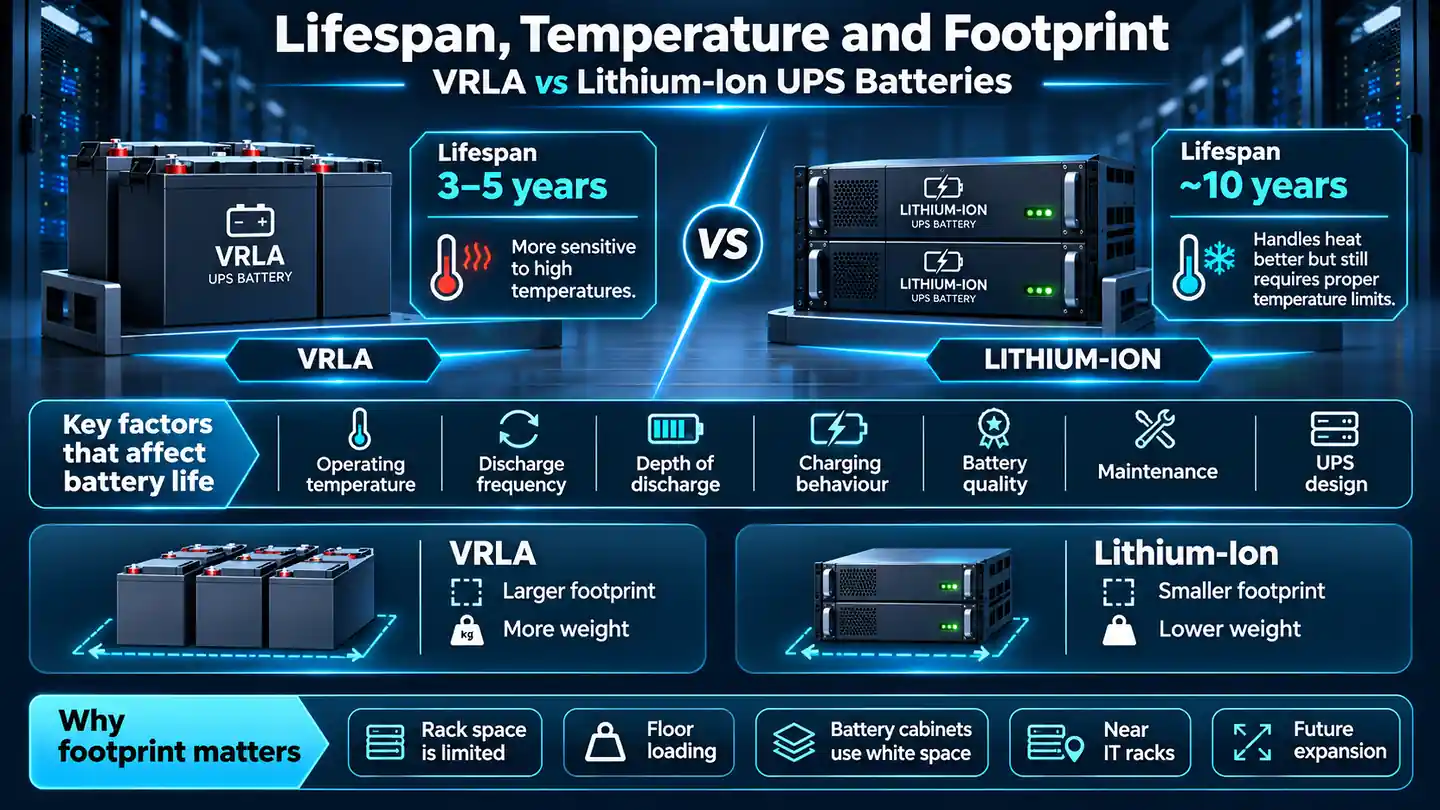
Things like cooling glitches, blocked airflow, or poor climate control can quickly degrade battery health and force an unexpected replacement. While lithium-ion handles heat better, it isn’t totally immune to it either. Manufacturers still set strict temperature limits, and staying within those bounds is essential to getting the full lifespan. Physical size is another major differentiator.
In VRLA vs Lithium-Ion UPS Batteries comparisons, lithium-ion batteries pack more energy into a smaller space, delivering the same backup runtime while taking up far less room and weighing significantly less than VRLA setups.
This physical difference is a huge deal when:
- Rack space is limited
- Floor loading is a concern
- Battery cabinets occupy valuable white space
- The UPS is installed close to IT racks
- The facility expects future expansion
To put this in perspective, imagine two server rooms needing the exact same amount of backup power. One has a dedicated battery room with floor space to spare.
The other sits in high-end commercial real estate where every single square meter counts toward your overhead. The same battery technology may not make sense for both. That’s why it helps to look at physical footprint as a financial decision rather than just a tech spec. After all, space costs money.
Initial Cost vs Lifecycle Cost
In VRLA vs Lithium-Ion UPS Batteries comparisons, VRLA batteries almost always come out ahead on the upfront price tag. They’re a well-established technology, easy to find, and cheaper right out of the box. However, the sticker price doesn’t tell the whole story when it comes to the real long-term cost.
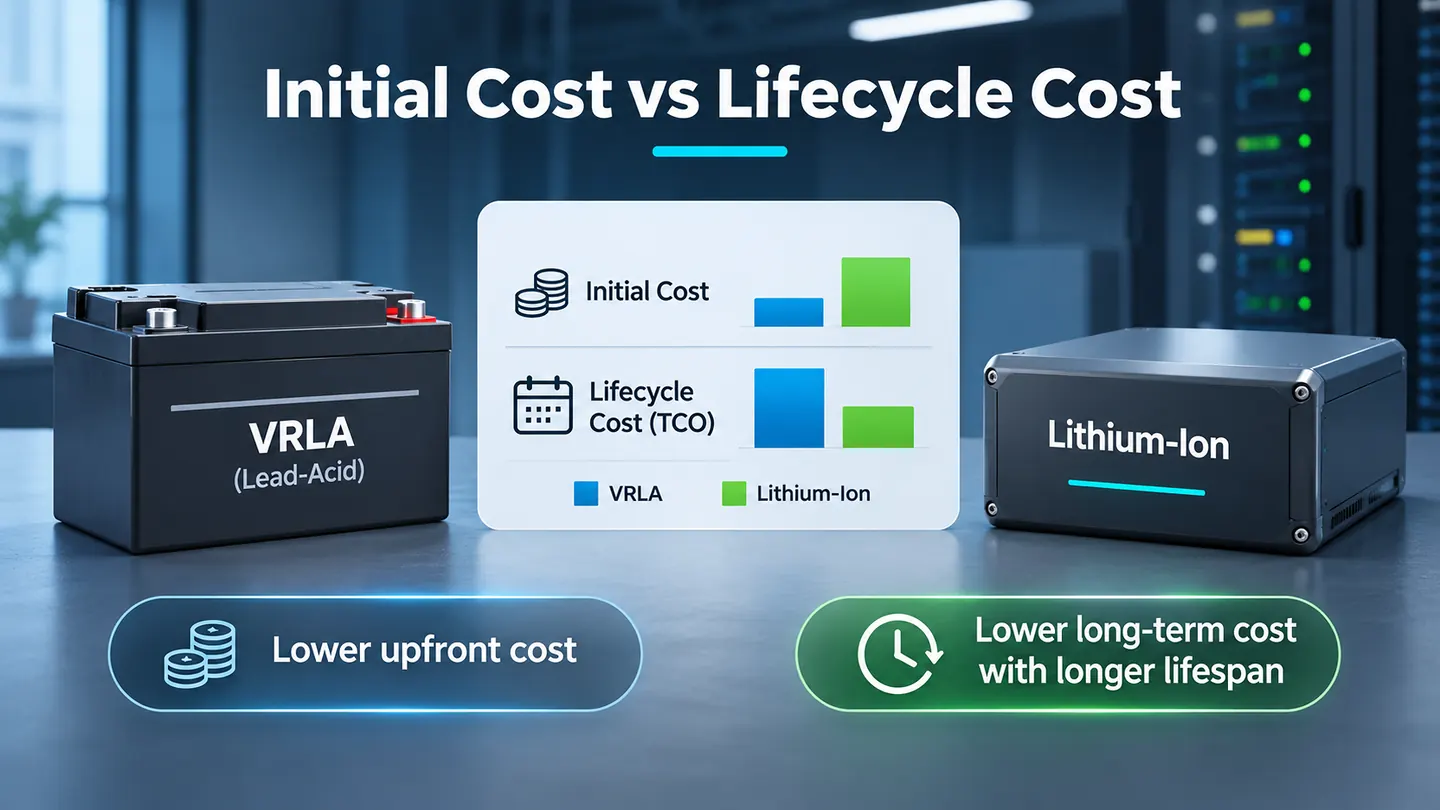
If your UPS system is built to run for a decade, you’ll likely have to replace a set of VRLA batteries more than once along the way. And each of those replacement cycles brings extra expenses beyond just buying new units:
- New batteries
- Shipping
- Installation labour
- Disposal
- Technician attendance
- Maintenance planning
- Potential service windows
Lithium-ion might cost more on day one, but because it lasts significantly longer, you avoid most of those extra replacement headaches down the road. In fact, Eaton’s lithium-ion UPS cost analysis points out that once you factor in lifecycle length and monitoring, lithium-ion starts looking a lot more financial sense—even if setup costs are higher initially.
Here is a quick side-by-side breakdown of how the costs stack up:
| Cost Area | VRLA | Lithium-Ion |
|---|---|---|
| Initial battery cost | Usually lower | Usually higher |
| Expected replacement frequency | Higher | Lower |
| Battery monitoring | Varies | Typically integrated through BMS |
| Space requirement | Greater | Usually smaller |
| Weight | Higher | Lower |
| Replacement labour | More likely during UPS life | Potentially much lower |
| Disposal events | More frequent | Less frequent |
| Long-term TCO | Depends heavily on replacement cycles | Can become competitive over longer periods |
To get an accurate picture when comparing VRLA vs Lithium-Ion UPS Batteries, you need to base your calculations on how long you actually plan to keep the equipment running. If you’re replacing the whole UPS in three years anyway, spending extra on 10-year lithium batteries doesn’t make much financial sense.
If the infrastructure will operate for ten or twelve years, the calculation changes considerably. That’s why procurement teams should look at the bigger equation combining UPS hardware, battery cost, expected replacements, and ongoing service rather than just comparing initial price quotes.
Runtime, Recharge and Monitoring
A common myth when evaluating VRLA vs Lithium-Ion UPS Batteries is that switching to lithium-ion instantly gives your UPS a massive boost in runtime. That isn’t actually the case.
How long your backup stays up mainly comes down to:
- Battery capacity
- Connected load
- Battery configuration
- UPS efficiency
- Battery condition
You can design both VRLA and lithium-ion setups for quick top-offs or extended runtimes. Adding extra battery capacity keeps things running longer during an outage, but it won’t increase your UPS’s maximum power output.
A 20 kVA UPS is still capped at 20 kVA, even if you hook up enough batteries to run it for two full hours. Where lithium-ion really shines, though, is in how fast it recharges and how well it handles frequent cycling.
Lithium-ion batteries handle far more charge-and-discharge cycles than classic VRLA setups. Eaton’s comparison highlights how lithium-ion can endure thousands of cycles, whereas standard VRLA batteries typically top out in the hundreds under typical UPS workloads. That makes a huge difference if your facility copes with frequent outages.
Monitoring is another major point of contrast. Because lithium cells must stay within strict voltage and temperature windows, a lithium system relies directly on an integrated BMS. That gives you much clearer insights into key details like:
- Battery health
- Cell conditions
- Temperature
- Remaining charge
- Fault conditions
You can monitor VRLA setups too especially in bigger installations but doing so often means adding extra hardware depending on your setup. At the end of the day, ask yourself:
How much visibility do we actually have into our batteries before something goes wrong?
Just because the status light on your UPS is green doesn’t guarantee every battery block inside is healthy.
Fire Safety and Manufacturer Requirements
When comparing VRLA vs Lithium-Ion UPS Batteries for safety, it’s never as simple as “lead-acid is safe, lithium is dangerous” or vice versa. Both options demand proper design, standard installation, and ongoing maintenance.
That said, lithium-ion needs extra care because damaged or mismanaged cells can suffer from thermal runaway a chain reaction where rising temperatures create even more heat. That’s precisely why lithium UPS setups feature a BMS and why system design, certifications, room conditions, and vendor guidelines are so important.
For larger stationary installations, local fire and building codes will often vary based on battery chemistry, overall energy capacity, and location. The current NFPA 855 Standard for the Installation of Stationary Energy Storage Systems outlines rules to minimize risks in stationary setups, covering key areas like fire protection, room ventilation, and thermal runaway prevention. Keep in mind that a small lithium-ion UPS won’t necessarily face the same strict installation requirements as a massive utility-scale battery system.
Project scale and local building codes play a huge part here. Here’s the right playbook to follow:
- Identify the exact UPS and battery system you’re using
- Confirm official manufacturer approval
- Double-check relevant product certifications
- Verify room and environmental requirements
- Confirm fire/life-safety requirements with the relevant consultant and authority
- Follow the manufacturer’s installation instructions
This step-by-step approach is crucial whenever you switch out battery tech.
Never attempt to swap lithium-ion batteries into a legacy VRLA unit unless the UPS manufacturer explicitly greenlights that exact setup. Charging profiles, communications interfaces, and safety protections differ significantly between the two.
Applications for Server Rooms and Data Centers
When comparing VRLA vs Lithium-Ion UPS Batteries for your facility, your environment plays a huge role in the decision. If you are managing a small server room, classic VRLA batteries might still be all you really need. They handle lighter workloads well, cost very little to swap out, and floor space usually is not a dealbreaker.
A business that already has trained service support and established VRLA replacement procedures may have little reason to change. On the flip side, lithium-ion starts making a lot more sense when:
- Space is restricted
- Weight matters
- Replacement access is difficult
- UPS lifecycle is long
- Battery monitoring is important
- Maintenance visits are expensive
- High cycle life adds value
In larger data centers, long-term costs and lifecycle planning become much bigger factors. Swapping out hundreds of heavy VRLA battery blocks is a massive undertaking compared to changing a small set inside a single 3 kVA rack system.
Large-scale battery replacements take serious effort, involving high labor costs, complicated disposal logistics, extensive testing, and careful schedule coordination. That is precisely where having far fewer replacement cycles translates into real operational savings. To wrap up, VRLA remains your best bet when:
- Initial budget is constrained
- Existing systems already use it
- Replacement infrastructure is established
- Space is readily available
- The expected system lifecycle is relatively short
Meanwhile, lithium-ion is the clear winner when:
- Long-term TCO matters
- Space is valuable
- Battery replacement is operationally difficult
- Monitoring requirements are stronger
- Weight reduction benefits the facility
Ultimately, you should never base your choice solely on battery chemistry alone. Instead, align your decision with your broader power protection strategy.
D3, a Tecnoware Distributor for Dubai and the GCC, covers UPS solutions from smaller business environments through modular, mission-critical infrastructure, with regional product selection, sizing and technical support. The useful role of the distributor and system integrator is therefore not simply supplying a battery. They help tailor the right UPS setup, battery design, runtime needs, and lifecycle expectations to fit your actual facility.
Procurement Questions to Ask
Before deciding on VRLA vs Lithium-Ion UPS Batteries, procurement and tech teams should double-check these key questions:
Which battery chemistries are actually supported by your UPS manufacturer?
Don’t ever assume you can just swap one chemistry for another.
What is the expected service life?
Ask for service-life expectations under the actual operating environment, not only design-life figures.
What operating temperature is ideal?
Just because a battery can survive across a wide temp range doesn’t mean it will last long under those conditions.
How many replacement cycles should we expect during the UPS lifecycle?
This affects total ownership cost considerably.
What does the warranty actually cover?
Make sure to review both the warranty period and its specific fine print.
What monitoring features come included?
Find out if you can track overall battery health, temperature, cell voltages, and state of charge in real time.
Is a dedicated BMS included?
This is especially important with lithium-ion.
How much space does the complete battery system require?
Compare cabinets, not only individual batteries.
What is the total installed weight?
This may affect floor loading and site planning.
How quickly does the system recharge?
This becomes critical if your facility faces back-to-back outages.
What runtime is guaranteed under your actual load?
Avoid comparing runtime numbers without knowing the exact load percentage behind them.
What routine maintenance is required?
Get a clear picture of necessary periodic inspections, ongoing testing, and servicing needs.
What is the plan for end-of-life disposal?
Plan your battery disposal and replacement logistics long before making a purchase.
Which safety certifications and standards apply?
Confirm this for the exact battery system and jurisdiction.
Who commissions the system?
Some battery platforms require manufacturer-approved commissioning.
UPS Battery Comparison Checklist
Before you lock in your decision on VRLA vs Lithium-Ion UPS Batteries, take a moment to walk through this sanity check:
- UPS compatibility — Does your current setup officially support the battery tech you’re eyeing?
- UPS expected life — Will the longer lithium-ion lifecycle actually be used?
- Initial budget — How critical is keeping that upfront capital expenditure low right now?
- Total lifecycle cost — Include replacements and labour.
- Runtime requirement — How many minutes (or hours) of backup power do you realistic safety margins call for?
- Physical space — Is battery footprint a constraint?
- Weight — Are floor weight limits a factor in your facility layout?
- Temperature — Can the room maintain recommended conditions?
- Cycle frequency — How often do you expect power outages to drain the system?
- Recharge requirement — How quickly should autonomy be restored?
- Monitoring — What kind of real-time health data do you need to see?
- BMS requirement — How is lithium battery behaviour controlled?
- Maintenance model — Who is going to handle routine checks and servicing?
- Replacement interval — How many changes are expected?
- Fire and safety requirements — What specific local codes or safety guidelines apply to this setup?
- Warranty conditions — Do you need certified installation or routine logs to keep your warranty valid?
- End-of-life disposal — How will batteries be handled responsibly?
- Expansion — Will you need to add more capacity as your power needs grow?
Going through this list helps make sure a single factor—like upfront sticker price—doesn’t end up dictating a decision that will impact your hardware setup for years to come.
initial cost + future replacements + ongoing maintenance + footprint + monitoring + recycling + downtime risks.
That holistic view is what transforms a VRLA vs Lithium-Ion UPS Batteries decision from a simple battery purchase into a smart, long-term power strategy. VRLA remains a tried-and-true, budget-friendly option for many setups.
Lithium-ion shines when longer lifespans, compact sizing, and fewer replacement cycles bring clear business advantages. Ultimately, the right choice is the one that continues to deliver solid value years after installation.